Overview
Qwen4-Max-Preview is a preview of the next-generation flagship multimodal model in Alibaba's Qwen family. Its model ID is qwen4-max-preview (alias qwen4.0-max-preview). The preview runs from 10:00 on 11 November to 24:00 on 25 November 2026 (UTC+8). Alibaba says the model will not change during that window and will be retired when it ends. It is offered only through the Alibaba Cloud Model Studio Token Plan subscription; pay-as-you-go access is not supported.
The model takes text, image and video input and returns text. It has a 1M-token context and up to 393,216 output tokens, shared by thinking and the final answer.
Strengths
- Alibaba positions it for coding, office work, frontend design and agent tasks.
- Thinking is on by default;
reasoning_effort can be set to low, medium or xhigh (the default).
- Function calling, web search and built-in tools, plus structured output with JSON Object and JSON Schema.
- Compatible with the OpenAI Chat Completions and Responses APIs and the Anthropic Messages API, so it plugs into tools such as Claude Code and Qwen Code.
Use cases
Interactive work in coding and agent tools such as Claude Code, Cursor, Qwen Code, Qoder and OpenClaw; trying the Qwen4 flagship early; screenshot, document and video understanding; and long-context code or document tasks.
Limitations
- It is a time-limited preview that will be retired after 25 November, so it is not a base for long-term projects.
- The Token Plan allows only interactive use inside coding and agent tools. Automation scripts, custom application backends and batch calls are not allowed, and Singapore is the only region.
- Alibaba has not published benchmarks, parameter counts, open weights or a license, and Artificial Analysis has not scored it yet.
- The docs do not say whether thinking can be turned off.
Versions & pricing notes
- There is no per-token USD price. Usage is deducted from Token Plan Credits. Personal plans cost $6 (Lite) to $43 (Pro) per month, with first-month discounts for new users on Lite and Essential.
- During the preview, Credits consumption is as low as 20% of the standard rate, and calls between 22:00 and 08:00 (UTC+8) get a further 60% off, or 8% of the standard rate.
- Compared with Qwen3.8-Max: both have a 1M-token context, but Qwen3.8-Max caps output at 131,072 tokens, is sold pay-as-you-go ($2 input and $6 output per million tokens in Singapore) and has an Artificial Analysis Intelligence Index of 34.
Hands-on: Blender low-poly blacksmith
Tested by the site owner: a single run, not a benchmark. Test date: 2026-11-11 (the first five models were tested 2026-11-06 to 11-08). The same Chinese prompt asked each model to build a low-poly medieval blacksmith shop in the local Blender install using Python (bpy), with no downloaded models; render a 1920×1080 image; save a .blend; and export a .glb.
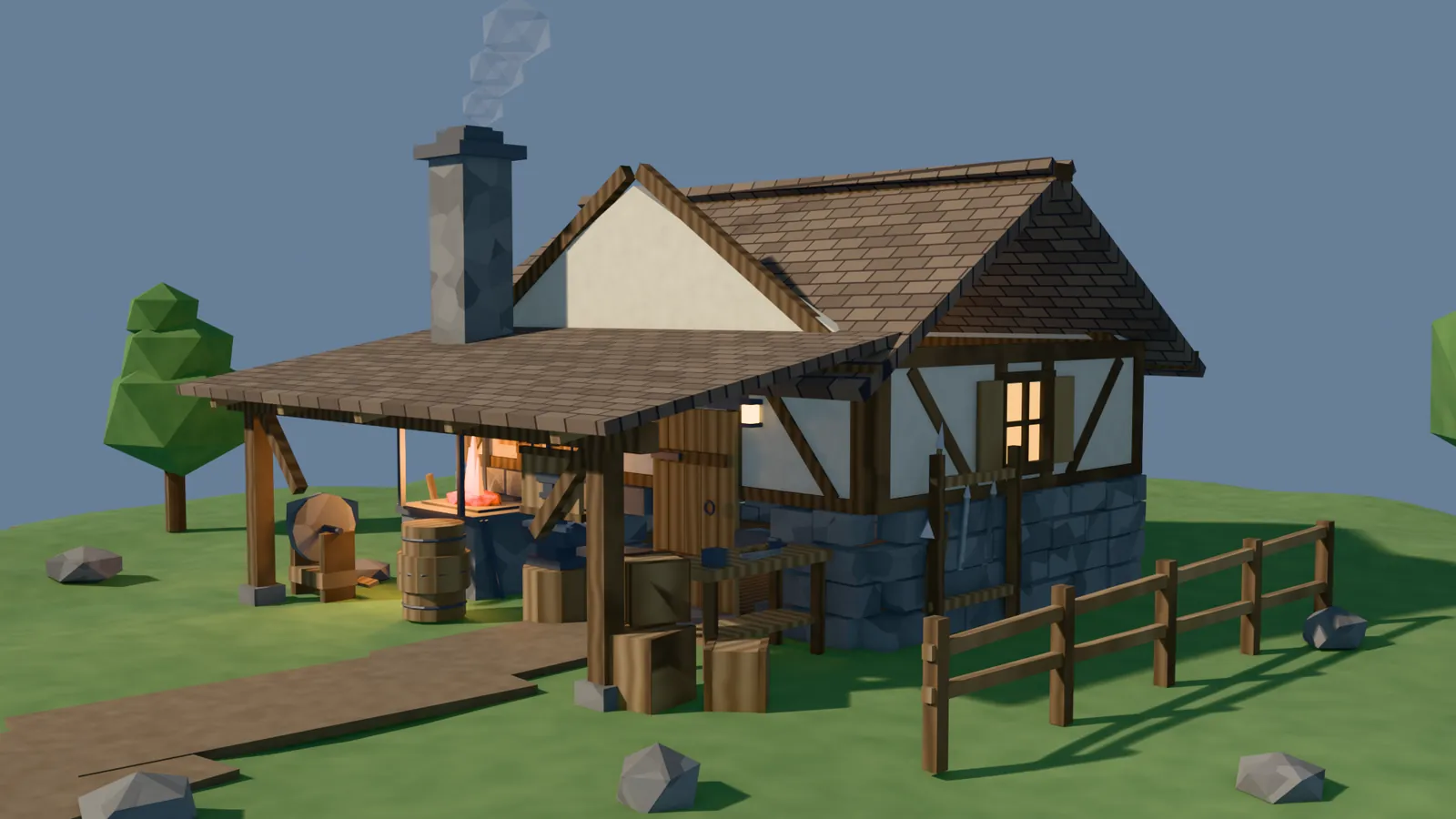
Qwen4-Max-Preview finished in Blender 5.2.3 LTS with one script of about 1,130 lines, run headless and rendered with EEVEE. Only the final outputs are on disk: the render and the .glb were first written at 21:39 and last at 21:56, so it ran the whole build at least twice; nothing earlier was kept.
- Requirements: 6 met, 1 partly met. A stone base of individually uneven blocks, a half-timbered upper storey with braces, a shingle roof, a capped stone chimney, a plank door with an iron ring and a lit, shuttered window, plus a lean-to on the left. Under the lean-to are a stone forge (hood, coals, flames, bellows), an anvil on a stump, a quench barrel, a grindstone and a workbench with a vice. By the script, the wall rack holds a spear, a sword and an axe (mostly the spear shows in the render); there are also a hanging sign, a lantern, crates, horseshoes, a fence, a path and trees. 9 of its 18 materials are procedural node materials (the main surfaces: stone, wood, roof, plaster, grass); metals, leather, dark stone and the glowing materials are flat colours, with no image textures. 5 lights and 1 camera; one 1920×1080 render; a .blend and a .glb.
- Look: a complete composition where every prop is easy to read, with warmth from the forge under the lean-to and the lit window. The whole scene is only 12,090 triangles, the most genuinely low-poly of the eight.
- Self-correction: only the last run's log was kept: no Python errors, just deprecation warnings. There are no intermediate renders and no written report. The script wraps the whole build in try/except, so errors are printed but never stop it. Its sky uses the NISHITA type that Blender 5.2 removed; that error was swallowed silently and the sky fell back to a flat colour.
- Remaining problems: the background is one flat grey-blue, and the edge of the grass cuts straight against it. The smoke is a few translucent icospheres and the flames are cones. The wood grain is stripy, the crates are crude, and the weapon rack is thin and easy to miss.
- Verdict: third of the eight and ready to show, but it left almost no record of checking or fixing its work.
The full comparison of eight models, with scores, is in Hands-on: a Blender low-poly blacksmith.
 Star Dream AI