Overview
MiniMax-M3.1-Flash is an open-weight model MiniMax released on 19 October 2026, which it describes as an efficient model for everyday work. It keeps the MoE design of MiniMax-M3 (about 428B parameters in total, about 23B active), accepts text, image and video input, returns text and supports up to 1M tokens of context.
Strengths
- Three changes from M3: the first three full-attention layers now also use sparse attention, routed experts and attention paths get quantisation-aware training, and DSpark speculative decoding replaces the earlier EAGLE-like multi-token prediction.
- Tunable thinking depth across five levels: low, medium, high, xhigh and max.
- Coding and agent workflows, with self-reported scores of 73.7% on DeepSWE v1.1 and 61.2 on NL2Repo-Bench.
- Computer use (self-reported 61.7 on OSWorld 2.0) and cybersecurity (self-reported 82.2 on CyberGym).
- Its Artificial Analysis Intelligence Index on this site is 29, above M3's 19.
Use cases
Everyday coding assistants, high-volume agent workflows, computer-use automation and security analysis, and teams that want to self-host a multimodal model at lower cost. MiniMax provides recipes for SGLang, vLLM and TokenSpeed.
Limitations
- In the model card's comparison table it trails larger closed models on some coding measures, for example 38.1 on Terminal Bench 4.0.
- MiniMax notes that results are for the official weights and third-party quantisations may differ; usable context and throughput depend on GPU memory and serving setup.
- The license is the custom minimax-community license, and the official docs do not state a maximum output length.
Versions & pricing notes
- MiniMax international, Standard tier: $0.15 input, $0.60 output and $0.015 cache reads per million tokens, half of M3's current price ($0.30 / $1.20).
- Weights can be downloaded from Hugging Face; Transformers and several other integrations are still in progress.
Hands-on: Blender low-poly blacksmith
Tested by the site owner: a single run, not a benchmark. Test date: 2026-11-06 to 2026-11-07. The same Chinese prompt asked each model to build a low-poly medieval blacksmith shop in the local Blender install using Python (bpy), with no downloaded models; render a 1920×1080 image; save a .blend; and export a .glb.
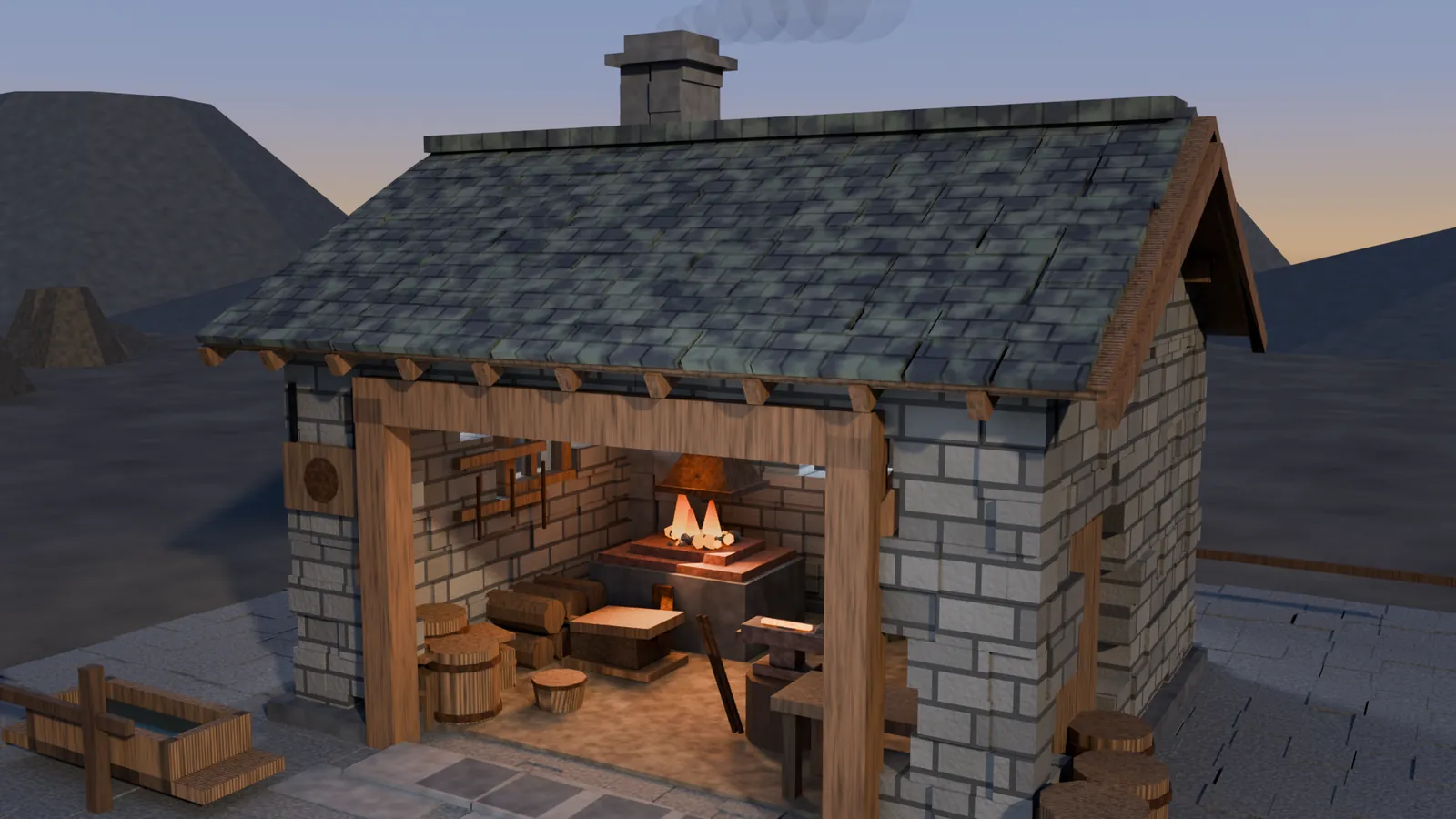
MiniMax-M3.1-Flash worked in Blender 5.2.3 LTS with one script of about 2,000 lines. The session paused overnight for about 10 hours.
- Requirements: all 7 met. Stone walls, timber posts and lintel, a slate roof, a stone chimney and arched windows; the front is an open workshop with no door leaf. It has a forge with a copper hood, an anvil and a wall weapon rack; 30 procedural materials; 11 lights and 3 cameras; three renders; a .blend and a .glb, with a script that reopens the .blend to check it.
- Look: good dusk light and forge glow, with convincing masonry and roof. The surroundings are a grey slab and dark hills and feel empty. Wall blocks stick out unevenly. The close-up looks roofless, and the forge hood does not reach the chimney.
- Self-correction: one of the most diligent of the eight. It made 16 render runs and wrote 12 documented patches, each fixing something seen in a render: over-lit walls, a chrome-like anvil, flame colour. When the sky gradient came out upside down, it wrote probe scripts that cast rays and read pixels, found the normal's sign was inverted, and fixed it. No Python errors at any point. It left no final report file.
- Verdict: steady quality, earned by repeated look-and-fix passes, but it took the longest.
The full comparison of eight models, with scores, is in Hands-on: a Blender low-poly blacksmith.
 Star Dream AI