Overview
Hy4 is the flagship model of Tencent Hy (formerly Tencent Hunyuan), launched on 4 November 2026 as the full release after Hy4 Preview. On Tencent Cloud TokenHub its model ID is hy4, with a 1M-token context, up to 960K input and up to 64K output, plus deep reasoning with preserved thinking, function calling, structured output and caching.
Strengths
- Visual understanding for the first time: fine-grained image work, complex chart analysis and mathematical visual reasoning, combined with tool calls.
- Computer use for the first time, through command-line and graphical interfaces, with dedicated training on professional software such as Blender and CAD.
- Office collaboration, financial analysis, front-end and game development, research workflows and search. Tencent says the hallucination rate fell from 12.95% in Preview to 7.2%.
- Its Artificial Analysis Intelligence Index on this site is 35.
Use cases
Office agents that need to read images and operate software, investment research and financial analysis, web and game development, and long-context research tasks. Tencent already uses it in WorkBuddy, CodeBuddy, Yuanbao and WeCom.
Limitations
- At launch the weights and system cards had not been released; Tencent said they would follow in the coming days.
- Tencent has not published the architecture or parameter count. Most results are internal or self-reported, and the hallucination rate is still 7.2%.
- Tencent's own review found its open-ended experimental design weaker than frontier models.
Versions & pricing notes
- TokenHub list price in USD: $0.834 input, $2.501 output and $0.042 for cache per million tokens, the same as Hy4 Preview.
- Until 23:59:59 on 31 December 2026 (Beijing time), usage is billed at 50% of list price.
- Hy4 Preview has no image understanding, and Tencent says a more cost-efficient Hy4 Flash is coming soon.
- Compared with the open-weight Hy3 ($0.132 / $0.528, 256K context), Hy4 has a longer context and image input but costs several times more.
Hands-on: Blender low-poly blacksmith
Tested by the site owner: a single run, not a benchmark. Test date: 2026-11-06 to 2026-11-07. The same Chinese prompt asked each model to build a low-poly medieval blacksmith shop in the local Blender install using Python (bpy), with no downloaded models; render a 1920×1080 image; save a .blend; and export a .glb.
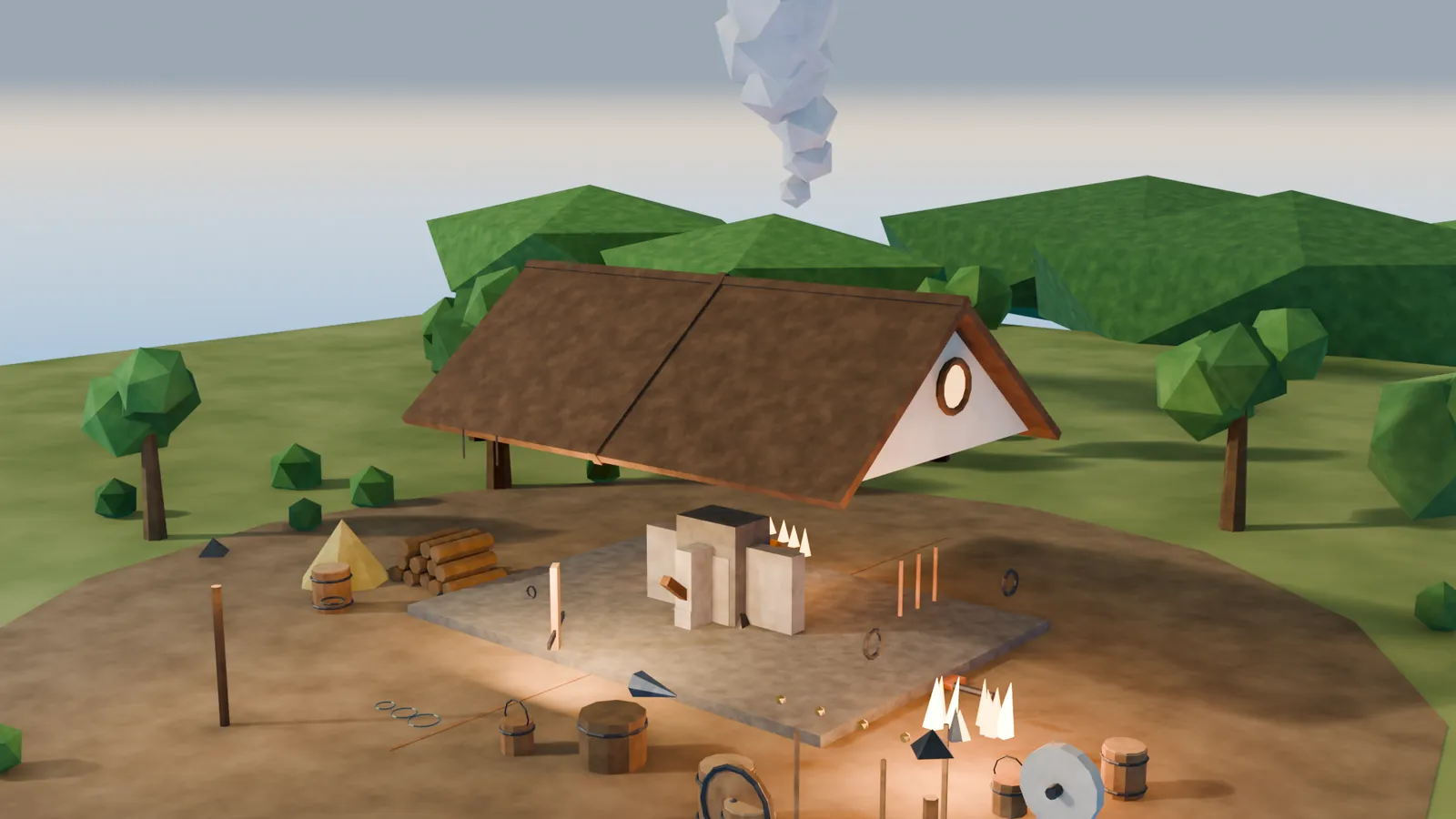
Hy4 worked in Blender 4.5.14 LTS with one script of about 1,210 lines and rendered with EEVEE.
- Requirements: 3 met, 3 partly met, 1 missed. The render shows no walls: the roof floats like two flat slabs above an empty floor, and there is no visible chimney, only smoke hanging in the sky. The .blend does contain a building mesh (1,786 faces), but it does not appear as walls in the render. The forge, anvil, weapon rack and other props are in the scene but look scattered; flame cones stand on bare ground outside the floor. It has 25 procedural materials, a 1920×1080 render, a .blend and a .glb.
- Look: the sky, hills and trees are pleasant, but the main subject is not recognisable as a building.
- Self-correction: all 5 runs reported BUILD_OK with no Python errors. Its checks were numeric only (pixel statistics, an ASCII preview, a GLB round-trip), and none caught the missing walls. The final image has the same layout as the first; only the sky and lighting changed.
- Report vs result: its build report says the walls, timber frame, door and 5 windows were built and the roof has 288 staggered tiles. None of that is visible in the render.
- Verdict: the pipeline ran, but the model did not notice the result was broken. This run failed.
The full comparison of eight models, with scores, is in Hands-on: a Blender low-poly blacksmith.
 Star Dream AI