Overview
GLM-5.3-Flash is an open-weight model Z.ai released on 26 August 2026, and the first natively multimodal model in the GLM-5 series. It is MIT-licensed. It is a mixture-of-experts model with 320B total and 18B active parameters, combining sparse and linear attention on a newly trained base. Z.ai says it is more capable than GLM-5.2 at about a tenth of the price. It accepts text, image, video and file input, returns text, and has a 1M-token context with up to 128K output tokens. In this site's data its Artificial Analysis Intelligence Index is 28.
Strengths
- Visual coding: building front-end projects from screenshots or screen recordings
- Office deliverables (PPTX, PDF, DOCX, XLSX) and financial research and modelling
- Video understanding and editing, and computer-use workflows
- Function calling, JSON structured output, context caching and streaming
- Efficiency: Z.ai says attention compute is about 3x lower and the KV cache about 4.4x smaller than GLM-5.3's
Use cases
Agents that need to read images and video, low-cost coding and office automation, and high-volume long-document processing. Z.ai also shows examples in Blender 3D scenes, Godot game prototypes and CAD reproduction; the GLM-5.3-FlashX-Legal variant targets legal research, contract review and drafting.
Limitations
- Thinking cannot be turned off (
thinking.type only accepts enabled).
- Z.ai notes its KV cache is still slightly larger than Kimi K3's and DeepSeek-V4-Flash's.
- Text reasoning is a little below the flagship GLM-5.3 (Intelligence Index 28 vs 32 on this site).
- The model card has no dedicated limitations section.
Versions & pricing notes
- API name
glm-5.3-flash; there is also a faster glm-5.3-flashx (about 200 tokens per second) and glm-5.3-flashx-legal.
- Z.ai international pricing: $0.15 input, $0.03 cached input and $0.50 output per million tokens; FlashX is $0.37 / $0.075 / $1.25. Cached-input storage is free for a limited time.
- That is about a tenth of GLM-5.3's price ($1.40 input, $4.40 output). On the GLM Coding Plan, Flash gets 3x the quota of GLM-5.3; FlashX is not yet on the Coding Plan.
Hands-on: Blender low-poly blacksmith
Tested by the site owner: a single run, not a benchmark. Test date: 2026-11-06. The same Chinese prompt asked each model to build a low-poly medieval blacksmith shop in the local Blender install using Python (bpy), with no downloaded models; render a 1920×1080 image; save a .blend; and export a .glb.
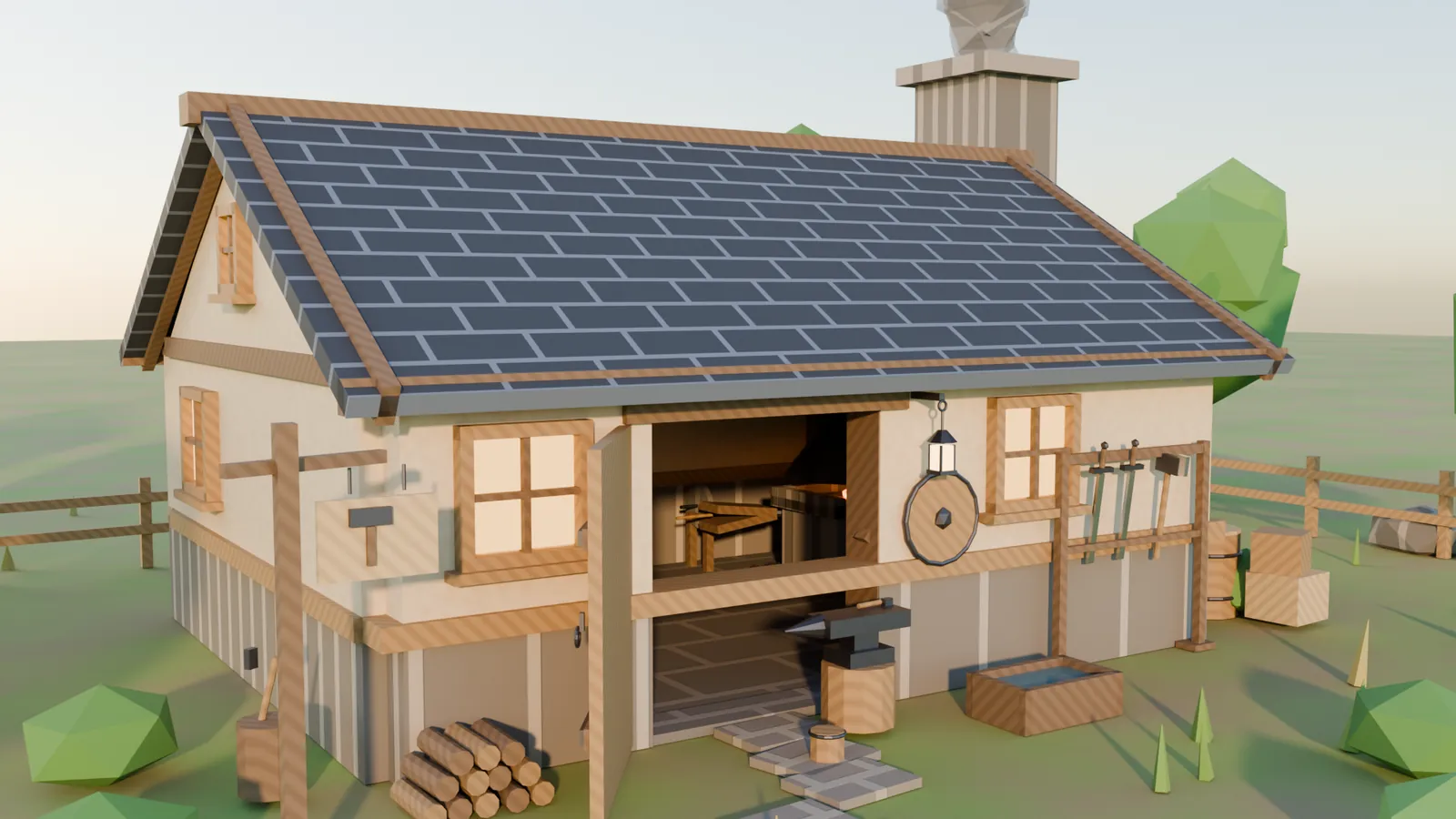
GLM-5.3-Flash made 10 Blender 5.2.3 LTS runs in about 11 minutes, with one script of about 1,075 lines.
- Requirements: 6 met, 1 partly met. It has a roof, timber beams, door, windows and a chimney, but the walls render as plaster and vertical boards, not stone. The forge, anvil and an outdoor weapon rack are all there; 27 procedural materials; 6 lights and 1 camera; one 1920×1080 render; a .blend and a .glb.
- Look: a clean, readable cartoon style with plenty of props. The blue slate roof's grid is so even it looks like a solar panel. The wood shows stripes, a beam crosses the main doorway, and the smoke is cut off by the top of the frame.
- Self-correction: the clearest error record of the eight. Its first 4 runs each failed on a different error: a node-link type error, a missing material key, an undefined variable, and the NISHITA sky type that Blender 5.2 removed. Each was fixed in the next run. Five more renders then adjusted the framing and colour. It left no final report file.
- Verdict: the fastest, with crisp debugging, but the stone walls and visual detail fall short.
The full comparison of eight models, with scores, is in Hands-on: a Blender low-poly blacksmith.
 Star Dream AI