Overview
ERNIE-5.5-Flash-Preview is the first post-trained model Baidu has built on its ERNIE 5.5 Flash Base, released in November 2026 as an intermediate post-training checkpoint. The base is a sparse MoE with 280B parameters in total and 14B active per token: 43 layers, with 512 routed experts (10 active) and one shared expert in each MoE layer, pre-trained on 33.5 trillion tokens. On Qianfan its model ID is ernie-5.5-flash-preview, with a 1M-token context and up to 1M output tokens including chain of thought; it is listed as a deep-thinking model.
Strengths
- Coding, especially long tasks that need planning and repeated refinement.
- Game development (Unreal Engine, Unity, Godot) and 3D modelling (Blender Python, CAD/FreeCAD).
- Knowledge work with spreadsheets, documents and slide decks, and content creation. Baidu says it balances capability with inference efficiency and fast decoding.
Use cases
Long-context coding agents, game and 3D prototyping, long research reports and financial spreadsheets. Many of Baidu's examples were produced inside an agent harness with external tools.
Limitations
- Baidu says training is not finished, so some capabilities may fall short; the official release will be improved from real-world use and feedback.
- Text only: in Baidu's examples, visual understanding came from an MCP tool, and Qianfan does not list it among its vision models.
- The announcement gives no benchmark figures in text.
- Default rate limits are 60 RPM and 1,000,000 TPM.
Versions & pricing notes
- Qianfan publishes prices only in CNY, which this site does not convert to USD. The current rates are a limited-time promotion at half the list price: at peak times (08:00–22:00), ¥1 input, ¥0.1 cache hits and ¥4 output per million tokens; off-peak (22:00–08:00) is half that, ¥0.5 / ¥0.05 / ¥2.
- The base model, ERNIE-5.5-Flash-Base, was released with open weights on Hugging Face on 5 November under the ERNIE 5.5 Flash Base license; Baidu says the Flash Preview weights will also be open-sourced under Apache 2.0.
- Compared with ERNIE 5.1, it has a longer context (1M vs 128K) and lower prices.
Hands-on: Blender low-poly blacksmith
Tested by the site owner: a single run, not a benchmark. Test date: 2026-11-13 (the first five models were tested 2026-11-06 to 11-08). The same Chinese prompt asked each model to build a low-poly medieval blacksmith shop in the local Blender install using Python (bpy), with no downloaded models; render a 1920×1080 image; save a .blend; and export a .glb.
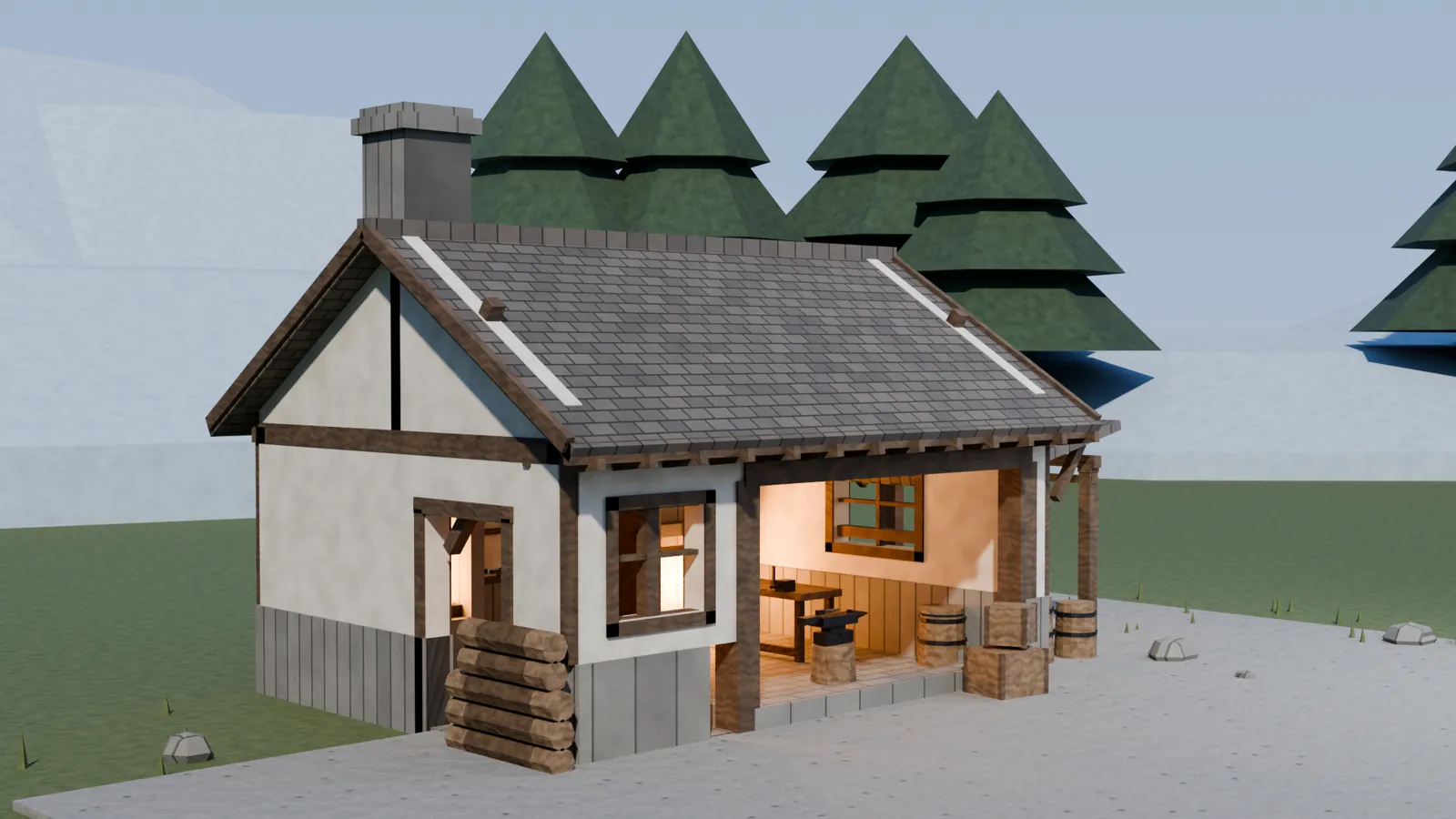
ERNIE-5.5-Flash-Preview did not run Blender headless. It used the BlenderMCP add-on to drive an open Blender 5.3.0 window, sending Python code in 47 calls; its final script is about 1,300 lines. By file times it took about 2 hours (17:07 to 19:10), rendering with Cycles on the CPU.
- Requirements: 5 met, 2 partly met. It has plaster walls, a timber frame, a gable king post, a tiled roof, a chimney, a side door and framed windows. But the stone plinth and the chimney render like vertical grey boards, not stone, and two white strips run down the roof. The render shows an anvil, a workbench with a vice, barrels, crates and a log pile. The script also builds a hearth, a weapon rack with two axes, a hanging sign, a second anvil, a quench barrel and a grindstone under a side shed, but none of them shows in the render, and no fire is visible. All 15 materials are procedural node materials, with no image textures; 6 lights and 1 camera; one 1920×1080 render; a .blend and a .glb.
- Look: a clean, tidy building with nice warm light in the open workshop and layered pines behind. But there are few props, the backdrop is a band of washed-out faceted "haze", a stray blue shadow sits on the right, and the forecourt looks like concrete.
- Self-correction: one of the most thoroughly recorded runs: 37 previews, close-ups and probe renders of single parts. The BlenderMCP log shows 4 code snippets that failed (type errors, a syntax error, an undefined variable), each fixed in later calls. The biggest problem took long to fix: from the first preview at 17:12 to the one at 18:09, a whole plaster panel covered the workshop opening. A close-up at 17:57 already shows the panel, but the opening was only cleared at 18:44. It left no written report.
- Remaining problems: no visible forge fire or weapon rack, stone that does not read as stone, a washed-out background, and the side shed only peeks in at the edge of the frame. The .blend is saved in Blender 5.3 format.
- Verdict: seventh of the eight. The building itself works, but the forge and weapons that make it a blacksmith's are missing from the render.
The full comparison of eight models, with scores, is in Hands-on: a Blender low-poly blacksmith.
 Star Dream AI