Overview
DeepSeek-V4.1-Flash-1017 is a minor update to DeepSeek V4.1 Flash, released on 17 October 2026 together with an update to DeepSeek's app and web models; API usage and pricing did not change. V4.1 Flash itself launched on 10 September 2026 as the smallest model in DeepSeek's new architecture family, with native visual understanding. Weights and code are MIT-licensed, and Hugging Face lists 763B total parameters. It takes text and image input, returns text, has a 1M-token context and up to 384K output tokens, and offers thinking and non-thinking modes (thinking by default). In this site's data its Artificial Analysis Intelligence Index is 33.
Strengths
- DeepSeek reports gains over V4.1 Flash in reasoning, coding, agent and visual benchmarks, with shorter execution times and outputs
- Native image understanding (DeepSeek-V4-Pro has none)
- The API supports JSON output, tool calls, the Responses API and the Anthropic API format, plus FIM completion (beta) in non-thinking mode
- Tuned for DeepSeek Harness, Tencent CodeBuddy and WorkBuddy
Use cases
Cost-sensitive coding agents, automation that needs to read images, analysis of long documents and large codebases, and general chat where a low price and solid capability both matter.
Limitations
- The model card does not state the active-parameter count, limitations or intended uses.
- No Jinja chat template is included; self-hosting needs DeepSeek's encoding scripts or the deepseek-recipe library.
- Text output only.
Versions & pricing notes
- API name
deepseek-flash. The models behind the old names deepseek-v4-flash and deepseek-v4-flash-vision-exp are retired; requests to those names are served by this model at the Flash price.
- DeepSeek peak pricing: $0.30 input (cache miss), $0.006 cache hit and $1.20 output per million tokens; off-peak is half price.
- Compared with DeepSeek-V4-Pro-0813 ($1.32 input, $3.96 output), it costs roughly a quarter to a third as much, yet scores higher on this site's Intelligence Index (33 vs 23).
- Third parties including DeepInfra, Fireworks AI and Together AI also serve it.
Hands-on: Blender low-poly blacksmith
Tested by the site owner: a single run, not a benchmark. Test date: 2026-11-06. The same Chinese prompt asked each model to build a low-poly medieval blacksmith shop in the local Blender install using Python (bpy), with no downloaded models; render a 1920×1080 image; save a .blend; and export a .glb.
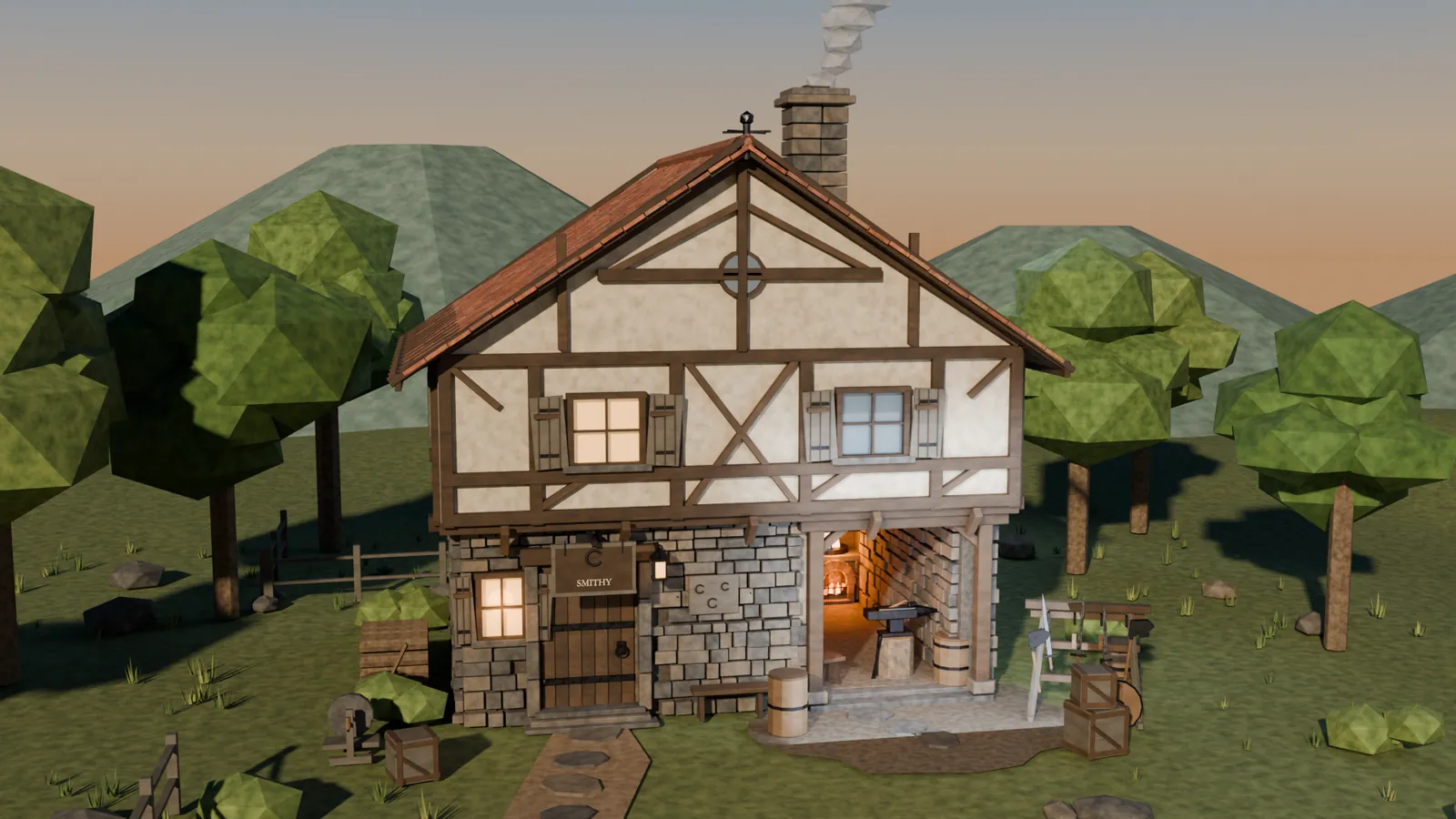
DeepSeek-V4.1-Flash-1017 finished every step in about 2.5 hours. It used six modular scripts (about 2,400 lines) in Blender 4.5.14 LTS.
- Requirements: all 7 met. Stone walls, timber frame, tiled roof, chimney, door and windows; a forge, anvil, weapon rack, tool board and many more props; 35 procedural node materials; 13 lights and 4 cameras; three 1920×1080 renders; a .blend and a .glb, plus a script that reopens both files to check them.
- Look: the most complete and coherent scene of the first five models tested, with sunset light, hills, trees and a path, well composed.
- Self-correction: it kept 960×540 previews and a clean final log. Earlier error logs were not kept, so how many errors it fixed is unknown. Its README matches the files and lists its limits honestly.
- Remaining problems: the smoke is a stack of blocks and the flames are white cones. Stones jut out unevenly on the forge bay's inner wall. At 127,742 triangles, it is heavy for "low poly".
- Verdict: the best of the first five models tested, close to ready to show. Claude Fable 5.2, tested later, came out cleaner and ranks first.
The full comparison of eight models, with scores, is in Hands-on: a Blender low-poly blacksmith.
 Star Dream AI